
Australia is facing two converging pressures in rodent management that businesses cannot ignore. Mouse populations in key regions have reached plague levels. In March 2026, the APVMA (Australian Pesticides and Veterinary Medicines Authority) introduced significant new rodenticide restrictions on the chemical class most used to control them.
This article sets out what has changed and what stronger control measures look like at each level of risk.
Rodent Control Australia 2026: Scale and Supply Chain Risk
Western Australia and South Australia are currently recording mouse densities of 3,000–8,000 per hectare in major grain-growing regions — well above the CSIRO’s formal plague threshold of 800–1,000 per hectare. This is not a regional problem. Australia’s integrated supply chain means rodents move with freight: grain, produce, and packaged goods passing through major distribution hubs carry contamination and infestation risk into warehouses, logistics centres, and food facilities in every state. The scale is comparable to the 2020–21 event, which caused approximately A$1 billion in agricultural damage according to the Grains Research and Development Corporation.
This is what has changed, and what better measures look like based on your level of risk.
Rodenticide restrictions in Australia: Why SGARs were restricted in 2026
Second Generation Anticoagulant Rodenticides (SGARs) — including brodifacoum, bromadiolone, and difethialone — have been the backbone of commercial rodent control for decades. They are effective. They are also, as the science now shows clearly, a serious secondary poisoning hazard.
Research published since 2023 has sharpened that picture considerably:
Liver residue analysis revealed that exposure to anticoagulant rodenticides was highly prevalent in nocturnal raptors across south-eastern Australia, with approximately 92% of all sampled birds containing detectable residues and a substantial proportion exposed to multiple compounds. Within this cohort, barn owls showed particularly high burdens, with around 80% exhibiting residue concentrations at levels associated with potential lethal or sublethal effects.
— Cooke et al., Science of the Total Environment, 2023
The use of SGARs presents a clear One Health risk by linking environmental contamination with impacts on animals and humans. Veterinary evidence shows that these compounds are a relatively common cause of poisoning in domestic animals, particularly dogs and cats, through ingestion of bait, contaminated prey, or scavenged carcasses.
— MSD Veterinary Manual, 2025
The APVMA’s March 2026 action reflects this evidence. SGARs can no longer be applied freely in certain outdoor and semi-exposed environments. Sites requiring ongoing SGAR use must have a documented assessment prior to treatment. For food production, logistics, and export-facing businesses operating under HACCP, BRC, or SQF audit frameworks, this also creates new compliance documentation obligations.
The practical upshot for many businesses: the chemical backstop they relied on between service visits is now constrained
Integrated Pest Management: The Compliant Alternative to SGARs
Integrated Pest Management (IPM) is a science-based pest control strategy that combines monitoring, prevention, and exclusion to suppress rodent populations, applying chemical treatments only when monitoring shows they are needed. Unlike a reactive, chemical-first model, IPM addresses the root causes of infestation — food, water, harbourage, and entry points — and documents each intervention.
The answer is not simply substituting one chemical for another. It is shifting from a reactive, chemical-first model to one focused on continuous monitoring, targeted intervention, and documented prevention. This approach is known as Integrated Pest Management (IPM).
Historically, rodent control relied heavily on chemical treatments to hold populations in check between service visits. With SGAR restrictions now in place, populations can build more rapidly in that gap, making the combination of industry and geography the key determinant of urgency.
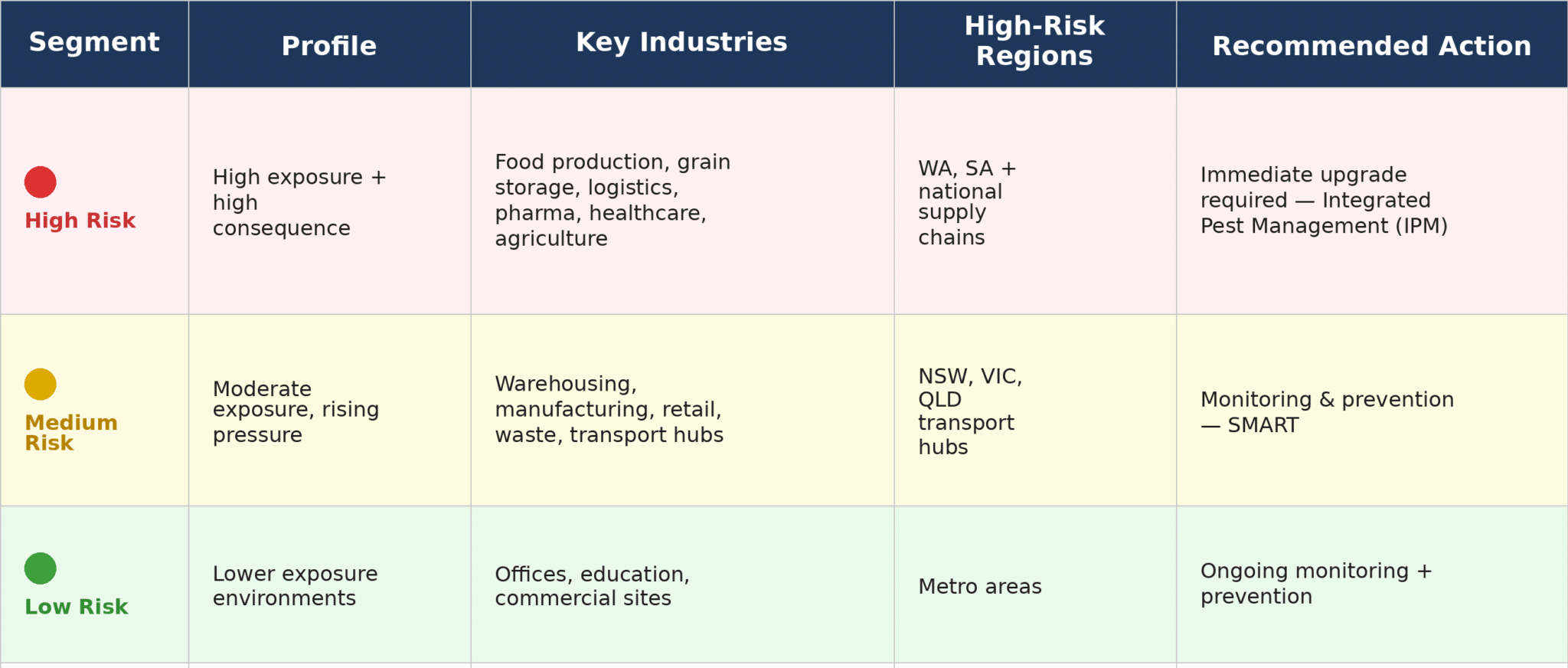
High-Risk Sites: Food Production, Grain Storage and Cold Chain
For food production, grain storage, pharmaceutical, cold chain logistics, and any operation in WA or SA – the response should be immediate: increase service frequency, conduct a site assessment under the new regulatory framework, and layer in electronic monitoring.
Medium-Risk Sites: Warehousing, Manufacturing and Transport
Warehousing, manufacturing, transport hubs — the priority is closing the detection gap. Continuous SMART monitoring provides 24/7 automated surveillance, instant capture detection, and an always-current audit record. Non-toxic, non-SGAR trapping aligned with the new regulations.
All Sites: Reviewing Your Rodent Management Contract
If your current contract was structured around quarterly visits and SGAR availability, those assumptions need reviewing now, as the sites best positioned moving forward will not necessarily be the ones applying the most treatment.
How Flick Is Responding to the 2026 SGAR Rodent Restrictions
Flick commenced its proactive transition away from SGAR baits ahead of the March 2026 restrictions. At each service visit, our technicians review site conditions and ensure the most appropriate, compliant, and effective rodent control measures are in place. We deliver commercial rodent management programs across WA, SA, VIC and nationally, structured around the new regulatory baseline.
The most important step any business can take right now is to reassess their current rodent management program against the new regulatory baseline, at a time when rodent pressure across Australia is already at its highest in years.
Request a rodent program compliance review →
Sources
- Cooke, R. et al. (2023) ‘Silent killers? The widespread exposure of predatory nocturnal birds to anticoagulant rodenticides’, Science of the Total Environment, 905, p. 166999.
- MSD Veterinary Manual. (2025). Rodenticide poisoning in animals. https://www.msdvetmanual.com/toxicology/rodenticide-poisoning
- CSIRO Agriculture & Food. Mouse plague thresholds and indicators.
- APVMA. SGAR Regulatory Decision, March 2026.
Enjoyed this article?
If you found this article helpful, sign up for our free Quarterly Newsletter to receive all our tips and tricks on pest control and washroom hygiene.
Sign Me Up!